
In the previous material we looked at BTC.D / ETH.D dominance and the role of TOTAL2 / TOTAL3 - how to understand where capital flows. Now let’s move on to the next topic: what is a real altseason and how to distinguish a wide rotation of capital from a local pump.
What is altseason really?
Altseason is not when one memcoin gave a plus of 100%. This is not when your friend bought a random token and got into the pump. This is not when everyone started writing in the feed that altos will fly soon.
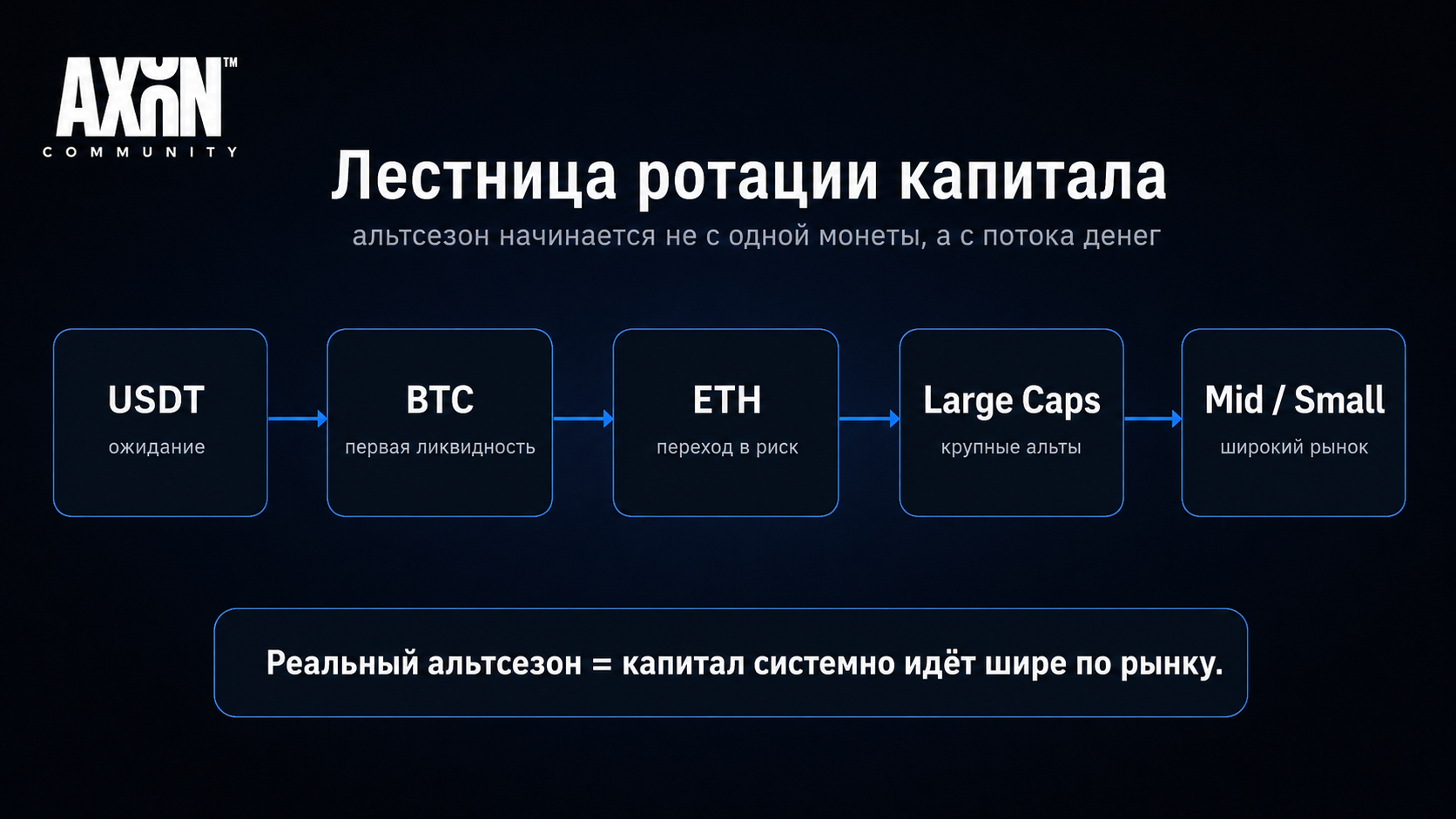
The real altseason is a period when alts systematically outperform BTC, and capital flows wider throughout the market. Not just one or two assets are growing, but entire groups of coins, sectors, large and medium-sized alts.
The main idea: altseason is not an emotion. This is capital rotation.
How capital usually moves through the market
Capital rarely flows straight into the riskiest assets. Usually the movement occurs in steps.
First, money goes into BTC, because it is the main and most liquid asset. Then, if the market feels more confident, capital begins to move into ETH. After that he goes to major alts. Then to the middle ones. And already in the late phase - into small assets, memes and everything that the market begins to buy indiscriminately.
This ladder is not always perfect, but the logic is almost always the same: the more the market is willing to risk, the further capital moves away from BTC.
Why one pump does not mean altseason
The market may be weak, but an individual asset will still give a strong movement. The reason could be news, listing, narrative, sector pump, market maker or simply local liquidity.
This is not altseason. This is a local story.
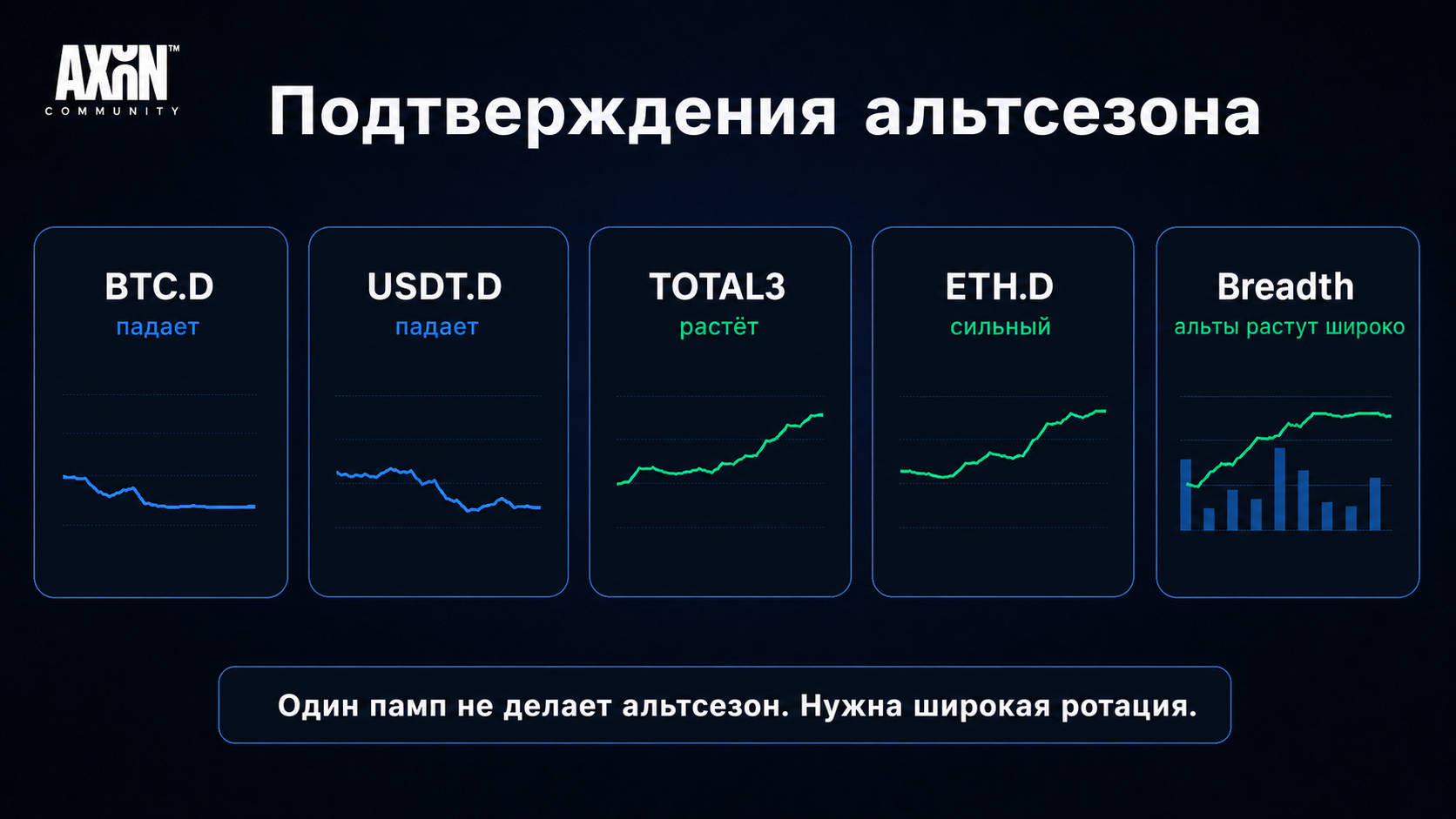
The altseason begins when the movement becomes widespread. When different groups of alts grow, when TOTAL3 confirms the influx of capital, when BTC.D declines, when the market really goes into risk.
The main signs of a real alt-season
- The first sign is that BTC.D is declining. Bitcoin is losing market share and capital is being distributed more widely.
- The second sign is that USDT.D is declining. Money leaves the stables and goes into risk.
- The third sign is that TOTAL3 is growing and breaking through important zones. This shows that the broader altcoin sector is receiving capital.
- The fourth sign is that ETH looks strong. Ether often becomes a bridge between BTC and alts.
- The fifth sign is that not just one sector is growing, but many assets. This is called market width. The more coins are involved in the movement, the stronger the signal.
Altseason phases
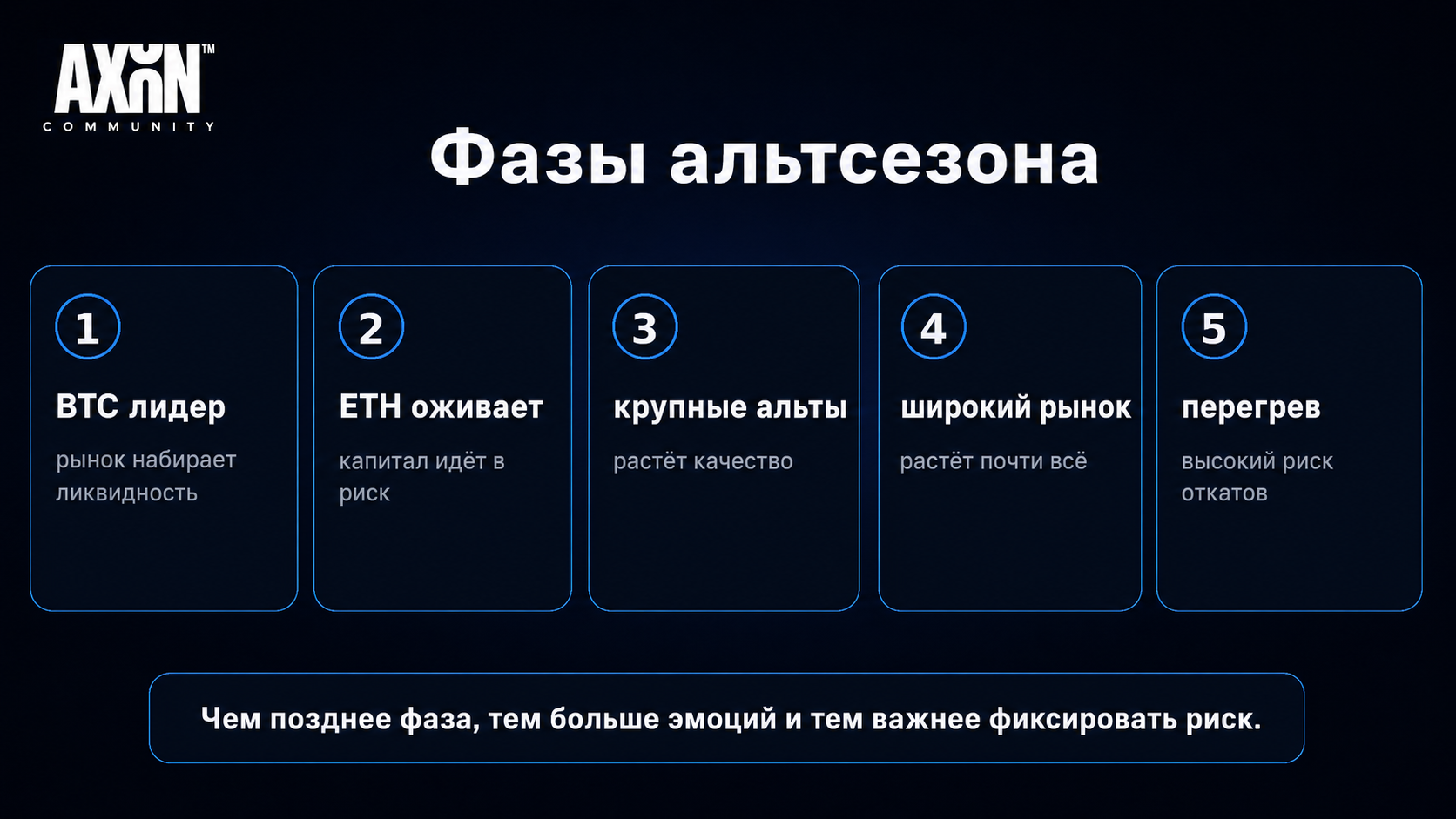
- The first phase is BTC leadership. The market is gaining liquidity, but the main focus is on Bitcoin. Alts may lag behind.
- The second phase - ETH begins to come to life. Capital becomes bolder and moves into a riskier, but still large asset.
- The third phase is large violas. Money goes into SOL, LINK, BNB, XRP, AVAX and other liquid assets. The market is already wider, but not yet completely chaotic.
- The fourth phase is the broad alt market. Various sectors are growing, strong movements appear in mid-cap and small-cap.
- The fifth phase is overheating. Almost everything is growing, people buy indiscriminately, the risk is underestimated. This is where many people come in late.
How to avoid getting into the late phase
The most dangerous part of the altseason is the moment when everything is already obvious to everyone. During this period, it seems to a beginner that the market gives money easily. But that's when the risk becomes greatest.
If everyone around only talks about alts, if new Xs appear every day, if people stop placing stops, if memes grow without logic, if funding is overheated, then you need to be more careful.
The professional task is not just to make money on the movement, but not to give away the profit on the final euphoria.
How to use altseason in trading
During the early phase, it is better to look for strong assets that are already showing relative strength. In the middle of the phase, you can work with sectors that receive capital. In the late phase, it is more important to take profits and not increase risk.
Altseason does not cancel risk management. On the contrary, it makes it even more important. The faster the market rises, the easier it is to believe that stops are no longer needed. It's a trap.
The market can be very profitable, but these are the times when mistakes cost more.
What is important to remember
Altseason is a wide rotation of capital into alts, and not one random pump.
Main confirmations: BTC.D is falling, USDT.D is falling, TOTAL3 is growing, ETH is strong, the movement is wide.
The later the phase, the more emotions and the higher the risk of buying the top.
The professional approach is not to guess the altseason, but to see its confirmation in the data.