
You can look straight at a chart and still not see the market at all. Cognitive biases in trading work quietly: price is already breaking your idea, while your brain keeps collecting proof that you are right.
That is why the most dangerous thing is not a bad forecast. The dangerous moment is when the forecast becomes part of your ego and you stop noticing everything that contradicts it.
One of the trader's most dangerous traps
Picture a simple situation. A trader opens a SHORT after a local reaction from resistance. The stop sits above the zone, risk is calculated, the idea looks fine. But price does not fall. It returns to the level, breaks it, and starts holding above.
At that point the market already asks an inconvenient question: is the scenario still valid, or is it time to exit? Instead of answering, the brain starts defending itself. On the hourly chart it finds a long upper wick — so the seller is supposedly still pressing. On the five-minute chart a red candle appears — there it is, the "reversal." And the fact that on the four-hour chart price broke structure upward somehow stops existing.
I have seen this scenario dozens of times in others and in myself. The longer the position sits in the red, the less a person analyzes the market and the more actively they explain why it is still too early to exit.
This is not stupidity and not a lack of knowledge. This is how confirmation bias works: the brain picks convenient facts, discards inconvenient ones, and keeps the feeling that the original decision was correct.
The problem is that the market is not obliged to support your version. It keeps moving, and you pay for the filtering of information — with a larger loss, a dragged stop, and the next trade opened already on emotion.
What confirmation bias is
Confirmation bias is the brain's habit of seeking and better remembering information that matches an already accepted opinion. Anything that argues with that opinion looks weak, random, or unimportant.
In ordinary life this is visible all the time. A person decides to buy a specific car and then mostly reads good reviews. Breakdowns get explained by poor maintenance from previous owners, and positive stories are taken as proof of the choice. The decision is already made; what follows is not a search for an answer, but a collection of justifications.
On the market the same thing happens, only faster and more expensive. You enter a LONG — the brain starts noticing support, bullish news, a positive funding rate, and growth forecasts. Funding rate is the periodic payment between participants of perpetual futures; by itself it does not prove direction, but in an open position it is easy to turn it into a convenient argument.
Signals against the trade get a different explanation. A level break is called false. Rising sell volume is a flush of weak hands. A structure break is manipulation. The stop wants to be moved because "the market needs more room."
The brain does this not because you are a weak trader. It is easier to keep a coherent picture of the world than to keep admitting that new information changed the situation. A mistake hits the sense of control, and a loss adds real pain from losing money.
In trading those two things connect. You defend capital and your own rightness at the same time. That is why a neutral chart after entry quickly turns into an argument you really want to win.
I have a simple check: if I can no longer calmly name an argument against my position, analysis has most likely ended. Defense of the idea has begun.
How bias looks in a real trade
Suppose a trader opens a SHORT on an altcoin after a sharp rally. On 1H the asset looks overheated: price has run far from the local base, there is reaction above, and the first red candle looks like the start of a pullback. The entry is logical, the stop sits above the high.
An hour later price returns to the entry. So far everything is fine. Then the high updates, but the stop is not hit yet. At that moment the trader opens a lower timeframe and finds a small bearish FVG there — a price gap between candles that sometimes becomes a reaction zone. They decide the fall will start exactly from it.
Price trades through the FVG and holds above. On 4H something else is already visible: the buyer absorbs sells, structure turns up, and candle closes get stronger. But the four-hour chart is now "too slow," so it can be ignored.
Then news joins in. The trader searches the ticker and opens posts from people who also wait for a drop. One writes about token unlocks, another shows a divergence, a third promises a quick liquidity sweep below. A positive listing headline gets scrolled past: it looks like advertising.
Every red candle is treated as confirmation. Even if price is bought back right after it, memory keeps only the moment of the drop. Every green candle gets a temporary explanation: short squeeze, manipulation, the last pump before the dump.
When price approaches the stop, the original plan is almost forgotten. Instead of "where did the idea break?" another question appears: "how do I get out at least flat?" The stop is moved, then another piece of size is added because the new price looks more attractive.
The ending usually looks brutally simple. The trade closes with a loss several times larger than planned. After closing, the trader looks at 4H again and notices what was visible hours earlier: the market stopped confirming the SHORT before the stop was moved.
In hindsight everything is obvious not because analysis suddenly improved. The position disappeared, and with it the reason to defend the original decision.
The most insidious part is that outwardly the trader stays busy with analysis. They switch timeframes, read news, draw new levels, and add indicators. But the goal of that work has already changed. They are not testing the idea — they are looking for a wording that allows them not to close. The more time spent on that defense, the harder it is to admit the market answered much earlier.
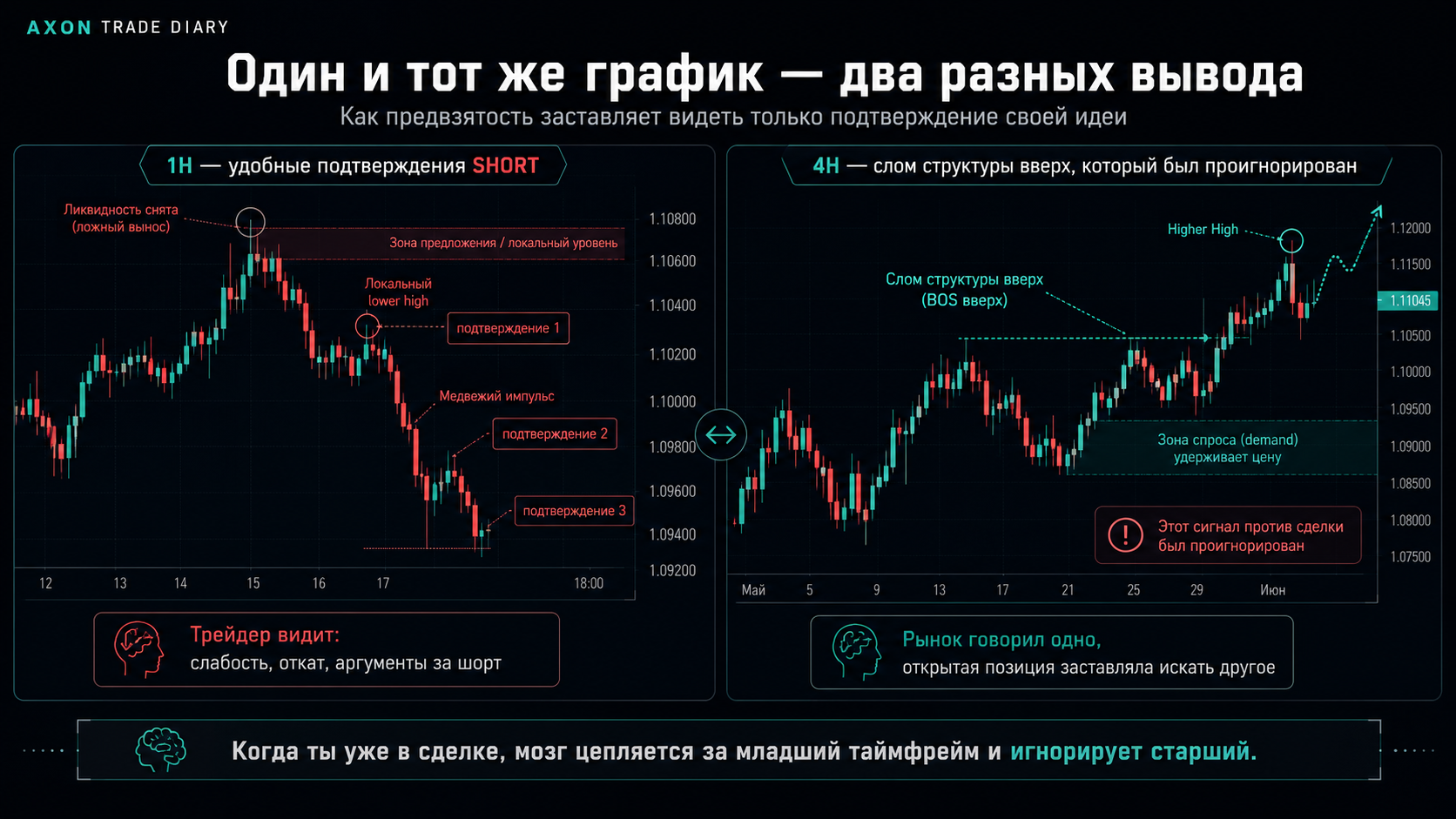
Three rules against bias
Rule 1 — look at the chart without an open position
An open position changes perception. Before entry you see several scenarios. After entry attention narrows to one question: will price go where you need it to?
So it helps to separate analysis from money for at least a few minutes. Close the position panel, hide PnL, or open a clean chart in another tab. Then ask yourself: if this trade did not exist right now, would I open it in the same direction with the same stop?
For example, you hold a LONG from support, but price closed below the zone and failed to reclaim it quickly. With an open loss it is easy to see a "good discount." On a clean chart the same area may look like a lost level and preparation for further decline.
I use an even stricter check: I describe the situation as if the position belonged to someone else. When personal money and rightness are removed from the wording, the weak spot in the scenario becomes clearer.
If you ignore this rule, every new fact will be judged not by meaning, but by whether it helps you keep holding.
Rule 2 — allow the reverse scenario before entry
The phrase "the market can go against me" sounds obvious, but by itself it changes nothing. You need specifics: which fact will show the idea stopped working, and what you will do after that.
Suppose a LONG is planned from the 1.80–1.84 zone. Scenario A: price holds the area, returns above 1.86, and gives an entry trigger. Scenario B: a candle on the working timeframe closes below 1.76 with no reclaim. In the second case the LONG is cancelled, even if you still like the coin fundamentally.
That note removes part of the pressure in the moment. When the market moves against the position, you do not need to invent a decision under stress. It is already tied to an observable fact, not to current fear.
In my plan there must always be a scenario invalidation point. Not just a stop price, but a reason why after it the original logic no longer works: lost level, broken structure, missing expected reaction, or a change in broader context.
Without a reverse scenario the stop easily turns into a random number you can move every time it becomes inconvenient. How to build a goal through process rather than reaction to the last candle is in how to set trading goals.
Rule 3 — change your mind with the market
Changing your mind does not make you weak. Weakness is continuing to defend an old idea after the facts have changed.
Imagine you waited for a SHORT after liquidity was taken above a high. Price did take the level, but instead of a sharp reclaim it held above, spent several hours there, and on the retest showed a buyer. The original scenario failed. That is not a reason to open a LONG immediately, but it is a reason to stop hunting for a SHORT where the market already shows something else.
I try not to jump from direction to direction after every candle. A change of mind should rest on the same set of criteria used for the first decision. If structure and the invalidation point have not changed, emotion is not new analysis. If the key fact changed, the old opinion is worth nothing.
A useful wording sounds like this: "I expected one scenario. The market showed another. So the old plan is closed, and the new one is only being checked." There is no attempt to revenge-trade instantly and no duty to always be in a position.
When a trader refuses to change their mind, they gradually start trading not price, but their reputation in their own eyes.

It also helps to separate revising an idea from emotional thrashing. Revision happens after a concrete signal: level lost, structure changed, expected reaction missing. Thrashing starts when direction flips with the color of the last candle. In the first case you update a hypothesis. In the second you just try to remove discomfort.
Why knowing about the bias is not enough
After reading it is easy to think: now I know about confirmation bias and will notice it immediately. In practice the mechanism turns on automatically. It does not warn you that it is about to filter information.
Worse, knowledge can create a new trap. A trader is sure they are self-aware enough, so they keep holding a bad position and call it calm. Or they specially look for one argument against the trade, quickly dismiss it, and count the check complete.
What works is not a promise to be objective, but a process that leaves less room for self-deception. Before entry the reason for the trade, the alternative scenario, the invalidation point, and the allowed risk should be written down. After entry only market facts change — not the rules under current PnL.
I would add a short four-question check:
- Which fact currently supports my position?
- Which fact contradicts it?
- What would have to happen for me to admit the idea is broken?
- Does my current action match the plan from before entry?
If there is no answer to the second question, that is not a sign of a perfect trade. More likely the brain has already removed the inconvenient part of the picture.
Here strategic thinking matters more than confidence. A normal plan does not try to guess one outcome. It keeps several options in advance and ties each to a concrete action.
Summary
Your beliefs about the market are not truth — they are a working hypothesis. Price tests it in real time and is not obliged to preserve your sense of being right.
The trader's job is not to never be wrong. The job is to notice when facts stopped supporting the idea, and not pay more to defend your own ego than the planned risk.