
The price can move in any way. Draw a beautiful rebound, break through the level, make a new high. But without volume, all this is empty sound. Volume shows the seriousness of any movement.
What is volume
Volume is not the number of trades. This is the number of contracts or coins that changed owners during one candle.
Example: one large player bought 1,000,000 BTC contracts from another large player - this is one transaction, but the volume is huge. 10,000 small traders bought 1 contract each - there are a lot of transactions, but the volume is small.
This is why high volume = large capital entered the market. It's the money that really moves the price - not the noise of the small crowd.
What it looks like on the chart
There are columns under the candles. The green bar is the volume on a bullish candle. Red is bearish. The higher the bar relative to the neighboring ones, the greater the volume on this candle.
There is no need to look at absolute numbers. See relatively: does this column stand out among its neighbors? So there was something important here.
5 main situations
📌 How to read volume:
1. High volume + strong upward candle
Krupnyak buys. The movement is serious - most likely it will continue upward. You can trust.
2. High volume + strong downward candle
Krupnyak sells. The movement is serious - most likely it will continue downward. Don't catch the knife.
3. High volume on reversal (hammer, level absorption)
This is the strongest signal. Krupnyak entered right at the level - the reversal was confirmed. Remember Lesson 5 about candles on levels? Add to this high volume - and the signal becomes many times stronger.
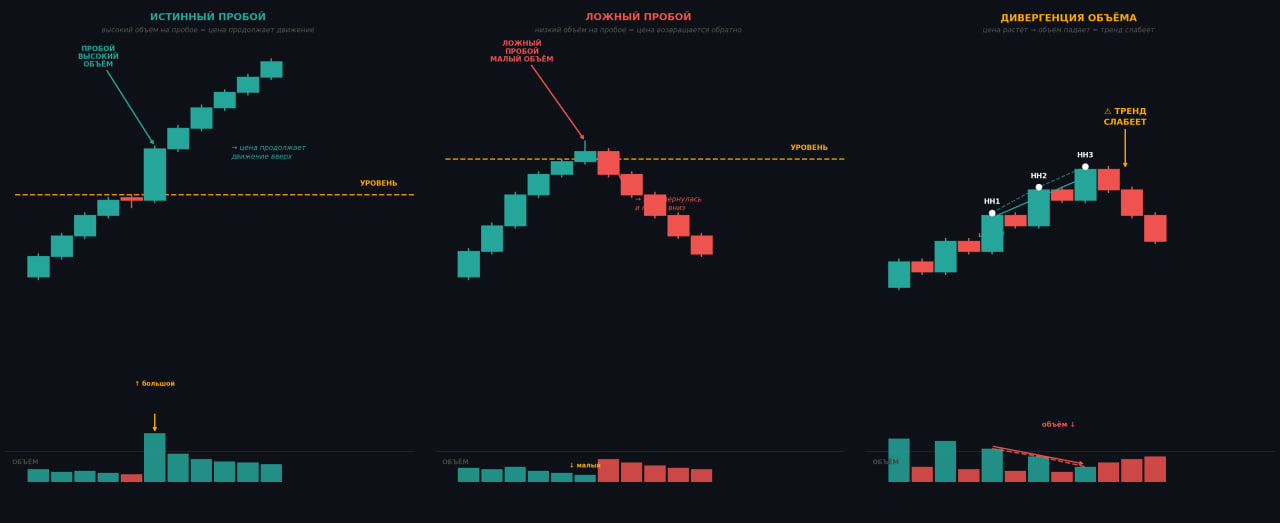
4. Breakout of a level on high volume
A true breakthrough. Big money has pushed through the level - the price will move further in the direction of the breakout.
5. Level breakout on low volume
False breakout. Nobody serious participated - the price will most likely return back. This is how a big man knocks out the crowd's feet.
Volume divergence
⚠️ Volume divergence is a quiet reversal signal
The price makes a new high (HH) - and the volume at this high is lower than at the previous one. The movement continues, but without the participation of big capital. This is called volume divergence.
What this means in practice: Buyers are running out of steam. New money is not entering the trend. Sooner or later, the trend will reverse - simply because there is no one to support it.
This is not a signal to enter right now - but a signal to be careful and not chase the trend.
Main rule
🔑 The main rule of volume:
Volume doesn't tell you where price will go. He says how serious the current movement is.
Use volume as a filter:
- I see a rebound from the level + high volume → I trust the signal
- I see a breakout of the level + low volume → I’m waiting, most likely false
- I see a new high + falling volume → be careful, the trend is weakening
Volume does not replace levels and candles - it confirms them. Three instruments together: level + candle + volume = the strongest signal.
Practice
Complete before moving to the next lesson:
Summary
- Volume shows the severity of the movement, not the direction
- High volume on a reversal is the strongest signal
- Low volume on a breakout is more likely a false breakout
- Level + candle + volume = maximum signal strength