
🎯 Goal of the lesson: understand what liquidity is, where it accumulates, what FVG (imbalance) is, and how to find an entry point with smart money, and not against them.
What is liquidity
Liquidity is not an abstraction. These are real orders from other traders.
When a big player (smart money) wants to buy 10,000 shares, he needs someone who will sell these 10,000 shares. Where can I find sellers? Where people have sell stop losses.
This is liquidity.
BSL and SSL
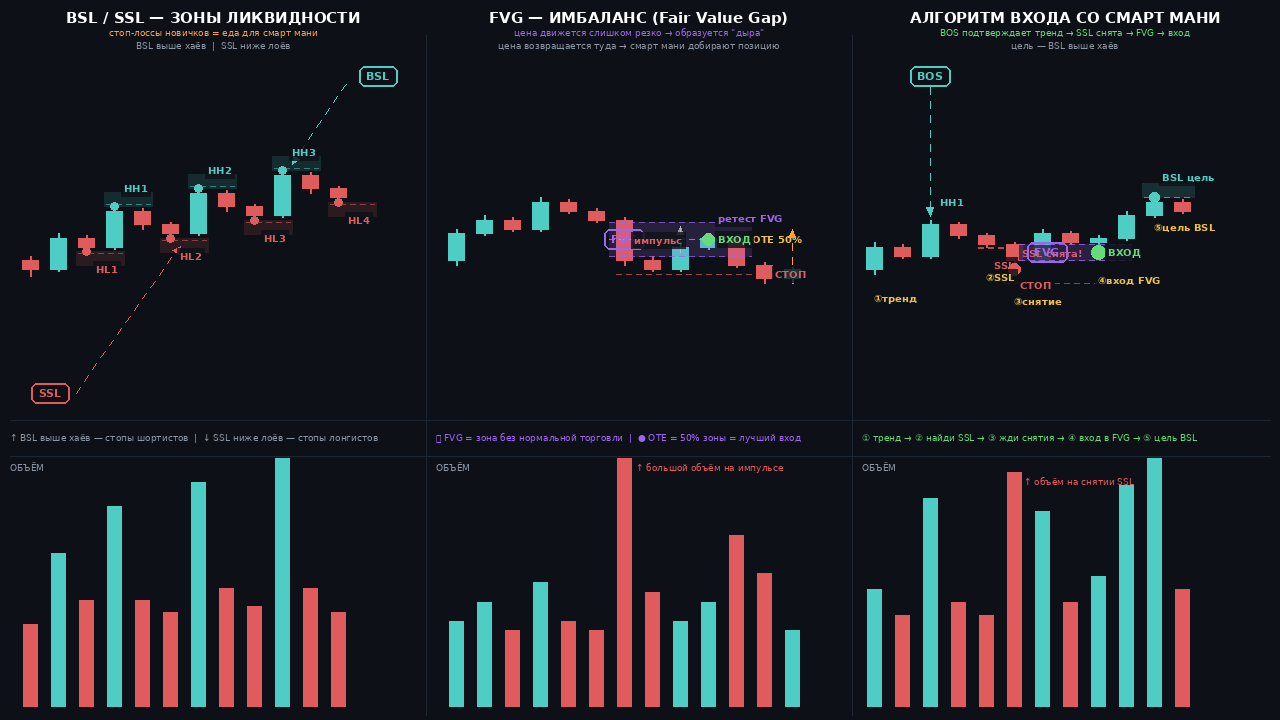
- BSL - Buy-Side Liquidity (buy liquidity) - is ABOVE the highs (HH). There are stop losses there for those who sold short. Smart money pulls the price there to buy from the “knocked out” shorts.
- SSL - Sell-Side Liquidity (liquidity for sale) - is BELOW the minimums (HL or LL). There are stop losses for those who bought long. Smart money pulls the price there in order to sell to the “knocked out” longists.
Simple formula:
- Before the price rises, smart money FIRST collects SSL (removes long stops)
- Before the price falls, smart money FIRST collects BSL (removes the stops of short sellers)
Where do beginners stop?
Beginners place stops predictably - and this is their main mistake:
- Are you trading long? → place the stop just below the last low (HL)
- Are you trading shorts? → place the stop just above the last high (LH)
Smart money knows this and uses:
Scenario 1 - “Long Shaving”:
- Uptrend price → makes HH1, HL1, HH2...
- Suddenly a sharp spike DOWN - below the last HL → SSL collected
- The longs' stops were triggered → smart money was bought cheaply
- The price turns around and flies up
Scenario 2 - “Short Shaving”:
- Downtrend price → makes LL1, LH1, LL2...
- Suddenly a sharp spike UP - above the last LH → BSL collected
- The shorts' stops were triggered → smart money was sold at a high price
- The price turns around and flies down
FVG - imbalance
FVG (Fair Value Gap) = Imbalance = Inefficiency. These are three words about the same thing.
When the price moves VERY sharply (for example, after liquidity is removed), it “jumps” over the area. Between the three candles a “hole” is formed - an area where there was no normal trading.
What FVG looks like (using the example of a bearish candle):
- Candle 1 (bullish): high = 100
- Candle 2 (very big bearish): open = 98, close = 78
- Candle 3 (bearish): low = 80
FVG zone = from 80 (low candle 3) to 100 (high candle 1). This is an area where there was no normal market.
Why does the price go back there?
- Because smart money is gaining position there
- They sold sharply down → FVG was formed → the price rolls back to FVG → smart money is sold again (at a better price) → the price continues to fall
FVG Key Rule:
- FVG is an ENTRY zone, not an exit zone
- We are looking for an entry In the middle of FVG (50% level = OTE - Optimal Trade Entry)
- Stop -BEYOND border FVG
How to log in with smart money
This is the main algorithm. Remember 5 Steps:
STEP 1 - IDENTIFY THE TREND IN THE SENIOR TF (H4 / D1)
Use BOS/CHoCH from Lesson 8. Answer the question: Is the market currently bullish or bearish?
STEP 2 - FIND THE SSL ZONE (if the trend is bullish)
Where did the stop losses accumulate under the latest lows? This is the target of smart money before the next growth.
STEP 3 - WAIT FOR LIQUIDITY REMOVAL
The price “pierces” the minimum (HL or previous low). This often looks like a sharp downward spike. Important: the candle mustRETURNback above the level (not close below!).
STEP 4 - LOOK FOR FVG AFTER TURN
After withdrawal, the price reverses sharply. An FVG forms in the reversal zone - this is your entry point. Wait for a retest of this zone.
STEP 5 - ENTER WITH THE CORRECT STOP AND TARGET
- Entrance: in the FVG zone (better at 50% level)
- Stop:below the SSL withdrawal point (below the spike)
- Target: next BSL (next high, new short stops there)
Newbie mistakes
❌ Mistake 1 - Setting stops “according to the textbook”
Slightly below the minimum = this is where the price is pulled. Place it deeper.
❌ Mistake 2 - Trading the breakdown of the minimum as a short
When the price breaks HL down, the newcomer shorts. Smart money is BUYING at this moment. You become their liquidity.
❌ Error 3 - Entering before withdrawing liquidity
Do you see a beautiful trend and go long? If SSL has not yet been removed, you may become a victim. Rule: the best longs are only AFTER removing the SSL.
❌ Error 4 - Ignore FVG
Do you enter immediately after a reversal without a retest? You have a bad risk/reward ratio. Wait for FVG - this is the entry point with a minimum stop.
❌ Mistake 5 - Thinking that smart money is “guessing”
No. They control the market through their volumes. Your task is to read their tracks and trade in the same direction.
Link to previous lessons
Everything you’ve learned before comes together into a single system:
- Lesson 7 (Supply/demand zones) → zones explain WHERE the price can reverse. Liquidity explains WHY this happens.
- Lesson 8 (BOS / CHoCH) → BOS confirms the trend → look for SSL to enter long. CHoCH signals a change → look for BSL to enter short.
- Lesson 9 (Liquidity + FVG) → full picture: trend + liquidity + FVG = entry point.
Practice
Complete before moving to the next lesson:
Summary
- BSL - short sellers’ stops are ABOVE the highs (smart money goes there to sell)
- SSL - longs’ stops BELOW the minimums (smart money goes there to buy)
- FVG - “hole” in the price after a sharp movement → entry zone
- Algorithm: trend → find SSL → wait for withdrawal → FVG → entry → target BSL
The main idea: do not trade the breakdown of the minimum - trade after the minimum has been broken and the price has returned back. This is where the big players come in.