
When a trader opens a trade, the first thing he cares about is how much he will earn. This is the most common and most dangerous mistake.
The main mistake of a trader
The correct approach is to evaluate the potential loss BEFORE entering. Not “how much I will earn”, but “how much I am willing to lose.”
Why people don't set stop losses:
- Fear of recording a loss and admitting a mistake
- Confidence that the price will reverse - “the analysis is correct”
- Fear that the stop will be taken away and then the price will go where it should
⚠️ The result is always the same - sooner or later such a transaction loses the entire deposit. One trade without a stop can wipe out months of profitable trading.
There is no strategy with a 100% win rate. We always make mistakes - the only question is how much control we have over these mistakes. Trading without a stop loss is a 100% risk per trade. One market move = loss of everything.
Mathematics of losses
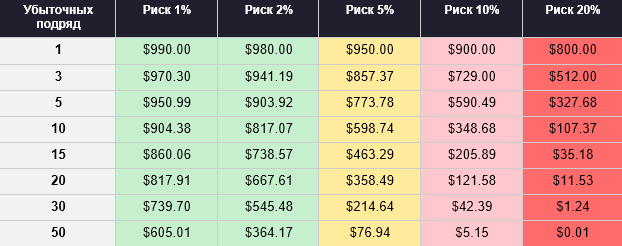
Initial deposit - $1,000. The table shows how much will remain after N losing trades in a row with different risks per trade.
| Risk per trade | 5 losses | 10 losses | 20 losses |
|---|---|---|---|
| 20% | $327 | $107 | $12 |
| 10% | $590 | $349 | $122 |
| 5% | $774 | $599 | $358 |
| 2% | $904 | $817 | $668 |
| 1% | $951 | $904 | $818 |
Risk 20% and higher - the deposit melts catastrophically quickly. 10 losses in a row = minus 89%.
Risk 1–2% - even 50 losing trades in a row leave more than half of the deposit. This is the room for mistakes.
💡 With a risk of 1%, you need 69 losing trades in a row to lose half of your deposit. Think about it - can you really make mistakes 69 times in a row if you trade with at least some analysis?
Profit mathematics
Many people think that for profitable trading you need to guess the direction 60-70% of the time. This is wrong.
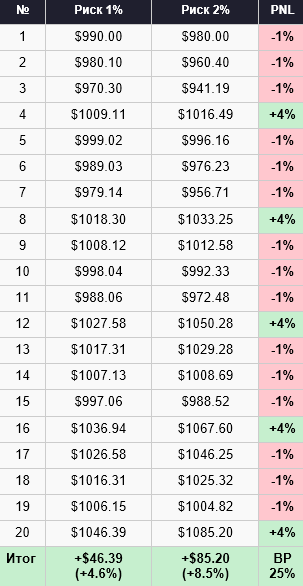
Deposit $1,000. Risk to reward ratio1:4. The win rate is only 25% - only every fourth trade is profitable.
Result for 20 trades with 75% unprofitable:
- Risk 1% per trade → profit +$46.39 (+4.6% of deposit)
- Risk 2% per trade → profit +$85.20 (+8.5% of deposit)
💡 Three out of four trades are unprofitable - and still in the black. This is the power of the right risk to reward ratio. The minimum you should use is 1:3. Trades with a ratio of 1:5 and higher allow you to cover losses and grow even with a low win rate.
Position volume calculation
Most traders open a position “by eye” or for a round amount. This is a mistake - volume should be calculated from the stop loss, and not from feelings.
TradingView
TradingView has a built-in tool - Long/Short (left panel). Use it like this:
- Select the instrument "Long Position" or "Short Position"
- Click on the entry level - a template with a red (stop) and green (target) field will appear
- Pull the red box to your stop loss
- Place the green field on the nearest target level
- Go to the tool settings → “Arguments” tab
- Enter the account size and risk percentage
- The required volume will appear in the “Quantity” field - this is what you enter on the exchange
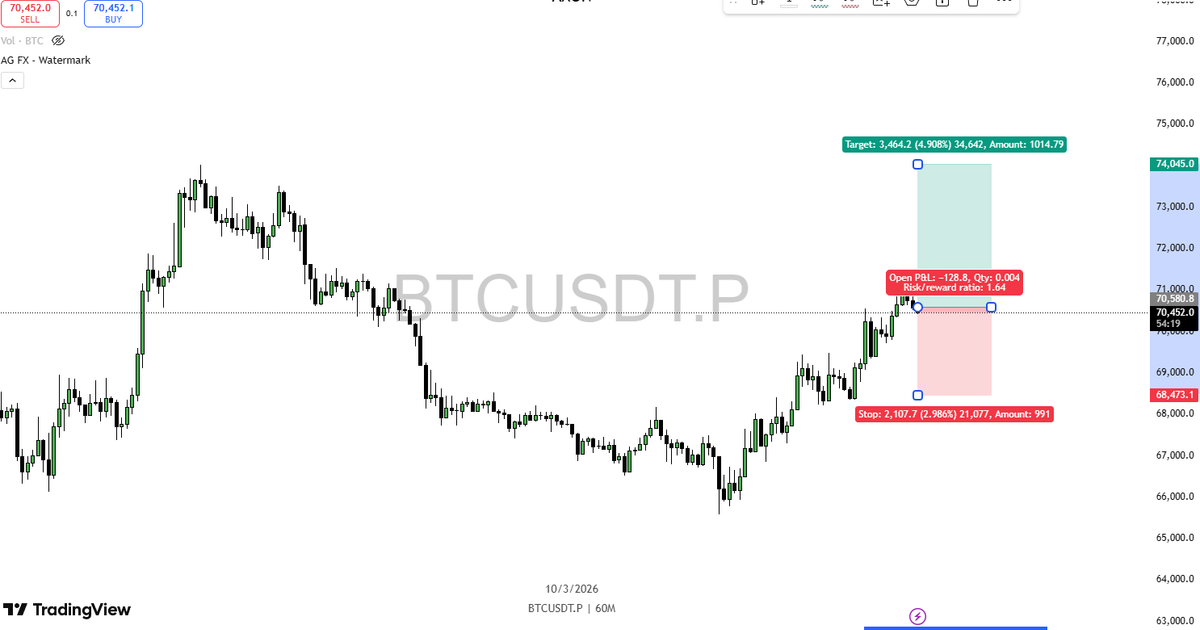
⚠️ Exchange commissions are not taken into account in the calculation. If you want to risk exactly 1%, set 0.85–0.9% in the settings. The exact adjustment depends on the exchange and stop length.
Example of manual calculation
Deposit $1,000, risk per trade 1% = $10.
Enter long at $1.80, stop at $1.71 - distance $0.09 (5%).
Volume: $10 ÷ $0.09 = 111 coins. If the stop is triggered, you will lose exactly $10.
Now if the stop is closer - $1.755 (distance $0.045, 2.5%):
Volume: $10 ÷ $0.045 = 222 coins. The risk is the same - $10. But the volume is twice as large.
💡 Key logic: Position volume depends on the length of the stop, and not on the amount you want to earn. Shorter stop = more volume for the same risk.
Small deposit
$100, $300, $500 – is it realistic to trade?
A common question from newbies is “I only have $200, what’s the point?”
The honest answer: there is a meaning, but not the one you expect.
A small deposit is not a problem. This is study
- On $200 with 1% risk, you risk $2 per trade. This is normal - you learn to execute trades, follow the rules and control your emotions
- The main goal of a small deposit is not to earn $1,000, but to learn how to trade correctly while losses are small
- A trader who lost $200 and understood why is worth more than one who accidentally earned $500 and doesn’t know how to repeat it
What to do with a small deposit:
- Trade the same rules as for $10,000 - 1-2% risk, always stop, ratio 1:3 minimum
- Looking at the percentage rather than the dollar return - +4.6% on $200 is $9, but that's the same result as +4.6% on $10,000
- Replenish your deposit regularly, if possible - not to win back, but to practice with real money
- Keep statistics - how many trades, what is the win rate, what is the average RR. It's more important than the amount
💡 Trading skill does not depend on the size of the deposit. A trader who knows how to maintain 1% risk on $300 will do the same on $30,000.
Distance rules
- The risk for each transaction is the same - 1–3% of the deposit. It doesn't matter how confident you are in the setup.
- Stop loss is set BEFORE opening a trade. Not after, not later
- The minimum risk-to-reward ratio is 1:3.Better 1:5 or higher
- Don't focus on one trade - trade a series. One loss solves nothing
- It's okay to make losses. It's part of the strategy, not a sign of failure
- Moving the stop to breakeven after the first goal is a mandatory rule, not an option
There is no analysis that always works. There is a discipline that works at a distance.
Practice
Complete before moving to the next lesson:
Summary
- Evaluate loss BEFORE entering, not profit
- 1-2% risk per trade - room for error
- Position volume depends on stop length
- RR 1:3 minimum - you can be in the black with a win rate of 25%
- Discipline works at a distance, analysis does not