
Most likely, you have already heard about futures, long, short, leverage and liquidation. But it’s one thing to know these words, and quite another to understand how it all works in a real deal.
Most beginners make mistakes not because they don’t know anything at all. More often the problem is different: a person understands futures too superficially. He knows that going long is for growth, short is for falling, leverage seems to increase the position, and liquidation is something bad. But as soon as it comes to the real deal, confusion begins: how does margin differ from position size, why is the profit not as expected, why does the loss grow quickly, why can you get a big minus with a small price movement.
In this article we will analyze the base calmly and in simple language. Without complicated terms and without unnecessary theory. The goal is that after reading you will have a normal basis: what futures are, how they differ from spot, how long and short work, what leverage does, why margin is needed, where position size comes from and why liquidation does not happen by chance.
This is a basic lesson. Not a strategy, not an advanced risk management and not a trading system. But without this base it is better not to get involved in futures at all.
Spot and futures: what's the difference
Let's start with the simplest thing.
Spot is a regular purchase of an asset. You buy a coin and become its owner. For example, we bought SOL for $100. If SOL has increased, your balance has increased. If SOL falls, your balance goes down, but the coin itself remains with you until you sell it.
On the spot, the logic is as clear as possible: you bought an asset, hold it, sell it more expensive or cheaper. You may lose some value if the coin falls, but the coin itself does not disappear simply because the price went against you.
Futures work differently. With futures, you don't necessarily buy the coin itself to store. You open a position for a price change. That is, you can make money not only on growth, but also on decline.
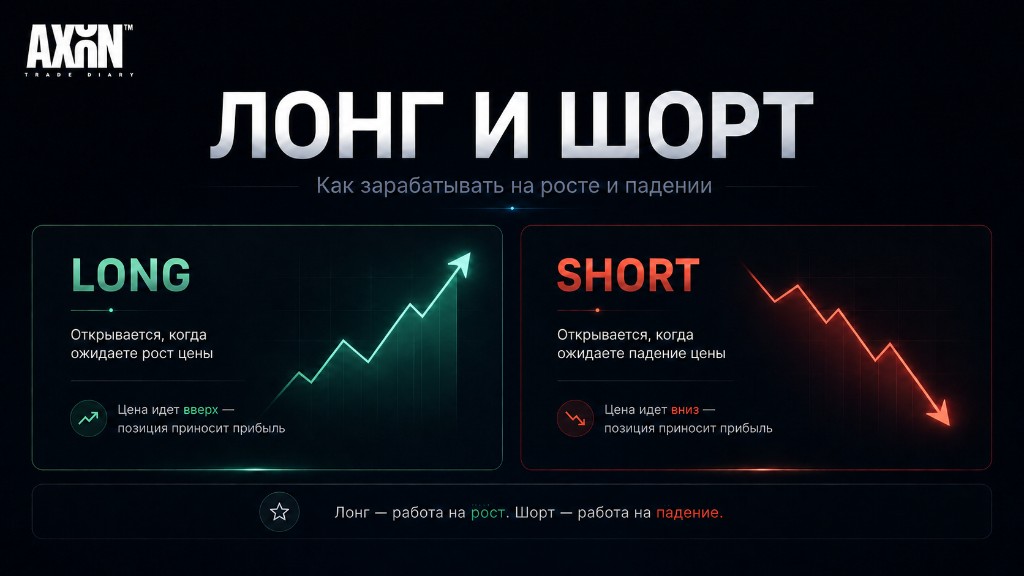
- If you expect growth, openlong.
- If you expect a fall, open short.
This is why futures offer more opportunity, but at the same time carry more risk. Here you can work on both sides of the market, use leverage and open a position larger than your margin. But if you don’t understand the basic mechanics, futures very quickly turn not into a tool, but into a way to lose your deposit.

Spot - ownership of an asset. Futures - working with its movement.
What is long
Long is a growth position.
You go long if you expect the price of an asset to rise. For example, BTC costs 69,000, you open a long position, the price goes to 72,000, and you make money on this movement.
The logic is simple: the price went up - the long trade brings profit. The price has gone down - the long trade is losing money.
It is important to understand that going long is not just a button to “make money on growth.” This is a deal that needs to have a plan. Where is the entrance? Where is the goal? Where is the point at which an idea becomes wrong? What will you do if the price goes against you?
If these answers are not available, this is no longer trading, but an attempt to guess.
What is a short
Short is a position to fall.
You go short if you expect the price of an asset to decline. For example, BTC costs 69,000, you go short, the price drops to 66,000, and you make money on this decline.
For beginners, shorts often seem strange. How can you make money on a dip if you don't buy a coin? But with futures, you are not trading the coin itself to store, but rather price movement. Therefore, if the price goes down and you have opened a short position, the movement goes in your direction.
Shorting is not a bet against the project and is not something bad. This is a common market instrument. The market doesn't always grow. There are corrections, weak assets, breakdown of the structure, selling pressure, and a bad market background. At such moments, shorting allows you to work with the fall, and not just sit and wait for everything to start growing again.
But short requires the same plan as long. Going short just because a coin has already gone up a lot is a bad idea. Just because an asset has grown does not mean that it must fall immediately. It may continue to rise, and then the short will quickly become unprofitable.
What is leverage
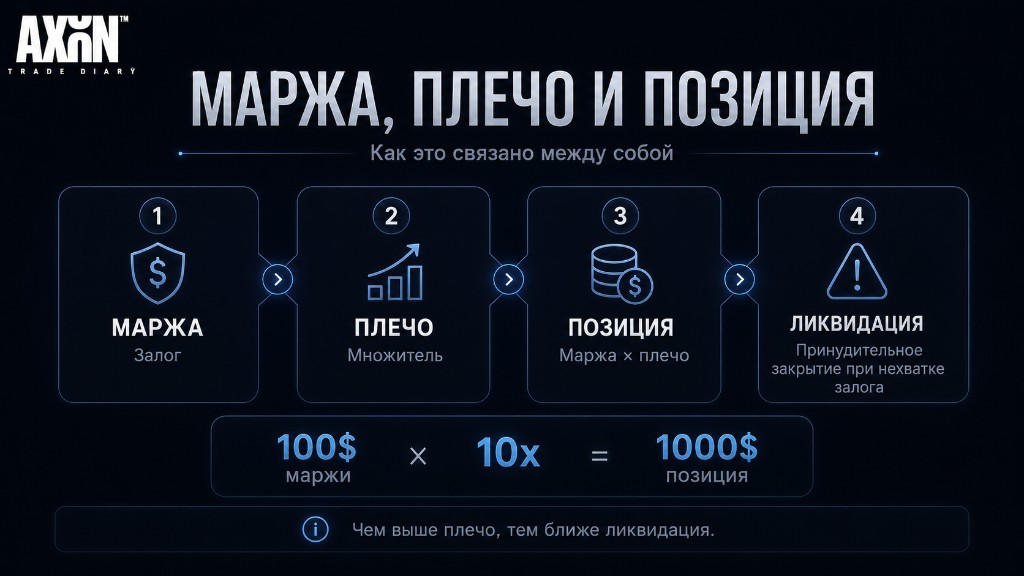
Leverage is a tool that allows you to open a position greater than your margin.
For example, you have $100 margin:
- leverage 5x → position size $500
- leverage 10x → position size $1000
- leverage 20x → position size $2000
Many beginners perceive leverage as a way to make money faster. Formally, the profit can actually be greater because the position size becomes larger. But the problem is that the loss also becomes larger.
Leverage does not increase your chance of making the right entry. It doesn't improve the quality of the deal. It does not turn a bad analysis into a good one. It simply increases the position size.
If the price goes in your direction, the result grows faster. If the price goes against you, the loss also grows faster.
Leverage is not a button to make money.It is a tool for managing position size. What makes it dangerous is not the number 5x, 10x or 20x itself, but the lack of understanding of the risk.
What is margin
Margin is the amount you deposit into a trade as collateral.
If you open a position in futures, the exchange does not always require you to pay the full amount of the position. You can only contribute a portion, and the rest of the position size is formed using leverage.
You have deposited $100 of margin and selected 10x leverage. The position size will be $1000.
In this example, $100 is the margin. $1000 is the position size.
And this is where confusion often begins for beginners. A person thinks that if he deposited $100, then he is trading for $100. But with 10x leverage, he is no longer trading for $100, but for $1000.
It is the position size that determines how much you will earn or lose as the price moves.
What is position size
Position size is the actual volume of your trade taking into account leverage.
Margin × leverage = position size
For example:
- $50 margin × 10x = $500 position
- $100 margin × 10x = $1000 position
- $100 margin × 20x = $2000 position
The larger the position size, the more your results are affected by price movements.
Let's say the price moved 2% in your direction:
- position $500 → profit about $10
- position $1000 → profit about $20
- position $2000 → profit about $40
But if the price moved 2% against you, the loss will work exactly the same: -$10, -$20, -$40.
Therefore, it is important to look not only at the margin, but at position size. Margin is collateral. Position size is what you actually trade.
Why profit and loss are calculated based on position size
In futures, profit and loss depend on the price movement relative to position size.
Let's say you opened a position for $1000. The price moved in your direction by 3%. Your result will be approximately $30 before commissions.
If the position was $200, then the same 3% would give approximately $6.
Therefore, two people can enter the same trade, using the same entry, with the same take and stop, but get completely different results. The reason is not that one exchange is better and the other is worse. Reason due to position size.
One opened a position for $200. The second one opened a position for $1000. The price movement is the same, but the result is different.
That's why you can't judge a deal solely by how much margin you put in. You need to understand the full size of the position and the distance to the take or stop.
What is liquidation
Liquidation is the forced closure of a position by the exchange when the collateral is no longer sufficient to hold the transaction.
If the price moves against your position, your loss increases. At some point, the exchange sees that the margin is not enough to cover further losses. Then the position is closed automatically.
This is liquidation.
This is usually not the case on the spot. If you bought a coin and it dropped 30%, you are just sitting with the drawdown. The coin remains with you until you sell it yourself.
Futures are getting tougher. If you use leverage and the price moves strongly against you, the position may be forced to be closed. Especially if the shoulder is high but the foot is not.
The higher the leverage, the closer the liquidation is to your entry point.
At 5x the position usually has more room before liquidation. 10x less stock. 20x even less. At 50x, even a small sharp move against a position can become a problem.
This is why beginners should not start with large shoulders. High leverage does not give more control. On the contrary, it reduces the room for error.
Why stop loss is more important than hope
The main mistake a newbie makes in futures is opening a position without a stop and thinking that the price will definitely return.
Sometimes it comes back. But it only takes one time when you don’t return to lose most of your deposit or get liquidated.
Stop loss is needed not because the trader wants to close in the red. A stop is needed to determine in advance the point where the idea of a trade no longer works.
- You opened a long position, but the price went below an important level - the scenario may be broken.
- We opened a short position, but the price broke through the level upward and consolidated - the idea may also be wrong.
Stop is not the enemy. This is a protection against a situation where one mistake becomes too costly.
In advanced risk management, the stop is associated with the size of the position and the acceptable risk per trade. But even at a basic level, you need to remember the main thing: futures without a stop are not trading, but hope.
Why futures are more dangerous than spot
Futures are more dangerous than spot for several reasons.
The first reason is leverage. It increases the size of the position, which means it increases both profit and loss.
The second reason is liquidation. On spot you can wait out the drawdown if you are willing to hold the asset. In futures, a position can be closed automatically if the price moves too far against you.
The third reason is emotions. In futures, the outcome changes quickly. A person sees a plus, then a minus, then a plus again, and begins to move the stop, increase the position, average, and fight back. All this quickly turns a normal idea into chaos.
The fourth reason is commissions and funding. Futures have trading commissions, as well as periodic payments between longs and shorts. For one transaction, this may seem like a small thing, but with active trading, such expenses affect the final result.
Therefore, futures are a tool for those who understand what they are doing. You don't have to be a pro from day one, but you should at least understand the basics before pressing buttons.
What is funding
Funding is a periodic commission between futures market participants. It exists to ensure that the futures price does not deviate too much from the spot price.
To simplify greatly, sometimes longs pay shorts, sometimes shorts pay longs. It depends on the market situation and the mood of the participants.
A beginner at the start does not need to delve deeply into funding formulas. The main thing to understand is that if you hold a futures position for a long time, the result can be affected not only by price movements, but also by additional costs.
For short trades this is often not critical. It is already important to hold a position for a long time.
What a normal futures trade should look like
A futures transaction should not begin with a desire to make quick money, but with a clear plan.
Before entering you need to understand:
- what asset are you trading
- where do you expect movement
- where is the entry, take and stop
- what is the position size and leverage
- what happens if the price goes against you or reaches your target
If these answers are not available, the deal is opened not according to the system, but based on emotions.
What this plan looks like on real setups, I show in the guide to my breakdowns. And if you work with Dump Radar signals — I separately covered how to calculate risk, notional, and leverage before entry.
This is especially dangerous in futures because emotions are more expensive there than on spot. The price can quickly go up several percent, and with high leverage this will already be a noticeable result on the deposit.
Simple example
Let's imagine that BTC costs 69,000.
You expect growth and open a long position. You have $100 margin and 10x leverage.
$100 × 10 = $1000 position size
If BTC rises by about 2%, your profit on the position will be about $20 before fees.
If BTC falls by about 2%, the loss will be about $20.
That is, a price movement of just 2% can give you plus or minus $20 on a $1000 position.
If you had opened a position of $2000 rather than $1000, the result would have been approximately twice as large. Both profit and loss.
This is why position size is so important.
The most common mistakes of beginners
- Take leverage as high as possible. High leverage reduces the margin before liquidation and increases emotions.
- Confuse margin and position size. Entered $50 from 20x - the position is already $1000.
- Trading without a stop. One sharp candle can quickly show the opposite.
- Averaging without a plan Often simply increases the loss.
- Count down with one trade. After the stop, the leverage is increased and the plan is disrupted.
- Copy a trade without understanding the risk. Same entry, but different deposits, leverage and margin - different results.
What to remember
Futures are a tool that allows you to trade price movements in both directions. You can go long on them if you expect growth, and short if you expect a fall.
Spot - purchase of an asset. Futures - work with a position on price changes.
Margin is a deposit. Leverage is a multiplier. Position size = margin × leverage.
Liquidation - forced closure when there is not enough collateral.
Stop Loss - protection against a situation where a mistake becomes too costly.
The main idea is simple: futures in themselves are neither good nor bad. This is a tool. Problems begin when a person uses it without understanding.
If you don't understand what your position size is, where your stop is, how much you can lose, and where the liquidation is, then the trade is entered too early.
First the base. Then practice. Then there is more in-depth risk management, market analysis and systematic work with transactions.
Futures provide opportunity, but require discipline. And the sooner you understand this, the less money will be spent on mistakes that could not have been made.
What's next
Now that you know the basics, see how to trade according to my analysis: limit orders only, stop before entry, move to breakeven.
To see where the market's capital is flowing — BTC.D and ETH.D.
A free base from scratch for beginners — AXON Start Bot.