
In the previous material we looked at altseason without illusions - how to distinguish a real capital rotation from a local pump. Now let’s answer a common question: why is BTC growing while alts stand still - and what to do about it in practice.
Main error of perception
The most common thought of a newbie: if BTC is growing, then alts should also grow. In practice, the market works more complexly.
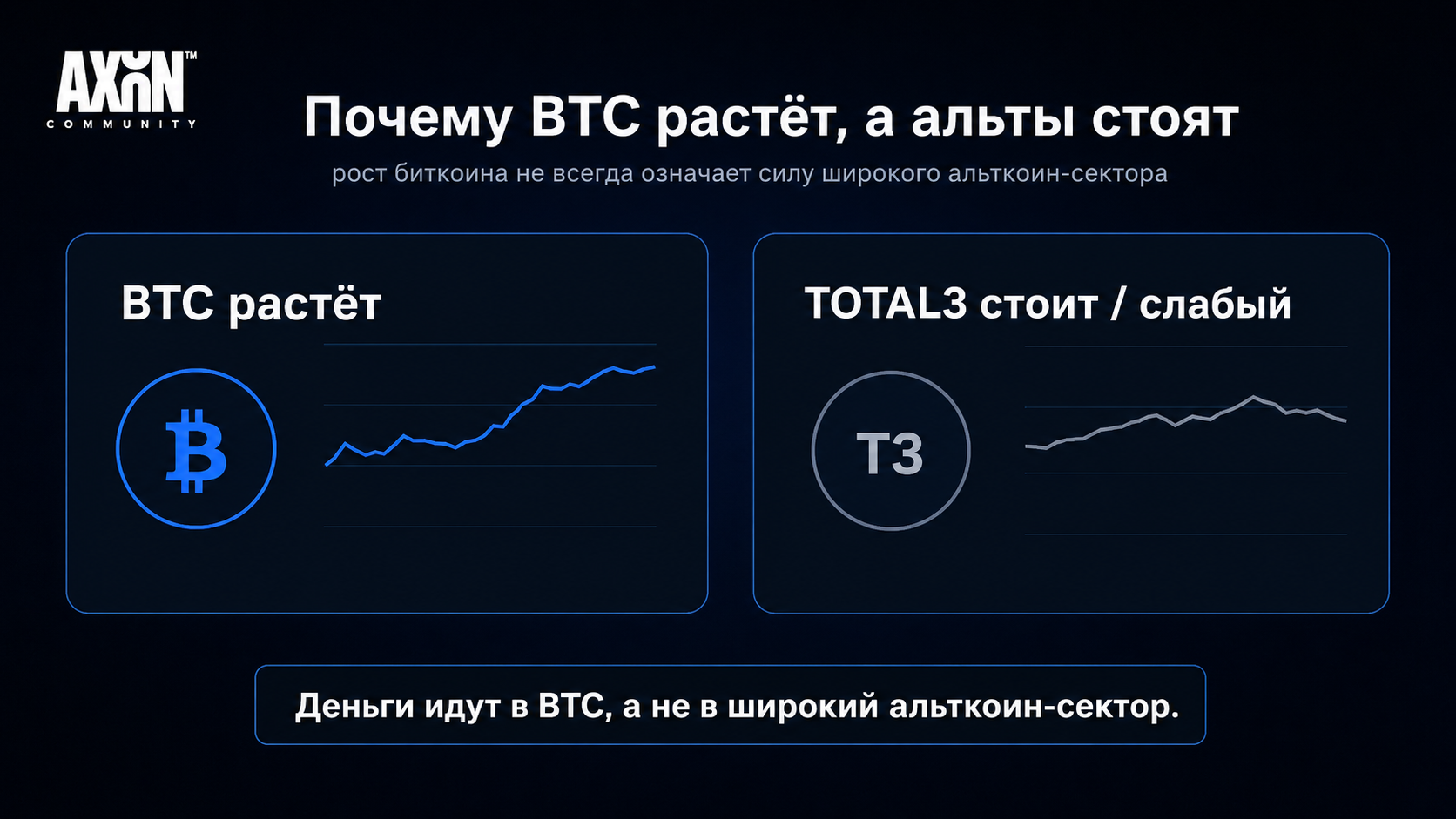
BTC can grow, but alts can stand. BTC can update levels while your portfolio barely moves. BTC may look strong, but the broader altcoin sector may be weak.
The reason is simple: the growth of BTC does not mean that money is flowing into the entire market. Sometimes capital goes into Bitcoin. Then BTC takes away attention, liquidity and trust, and alts remain on the sidelines.
Money goes where the market sees strength
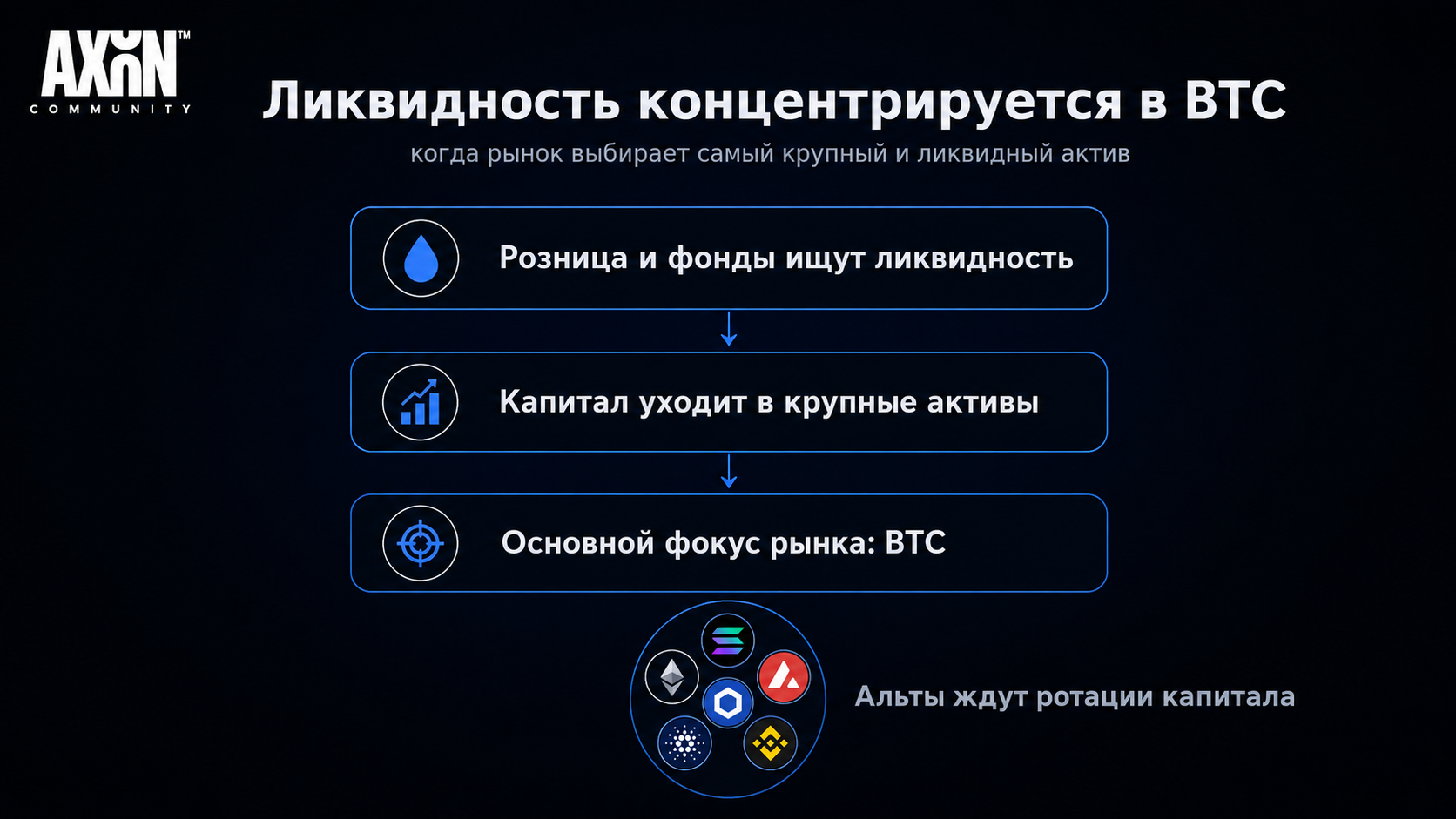
Capital is not distributed evenly. He goes where the best combination of liquidity, confidence and expectations is now.
BTC is the largest and most liquid asset within the crypt. In times of uncertainty or institutional interest, this is often where money goes first. Alts are further down the risk scale. For them to start growing actively, the market needs more confidence and more appetite for risk.
Therefore, the situation of BTC is growing, alts are not strange. This is a normal phase of the market, when capital is not yet ready to go wider.
BTC.D as main answer
- BTC.D shows Bitcoin's market share. When BTC rises and BTC.D rises, it means that Bitcoin is strengthening relative to the rest of the market.
In this phase, alts may grow weaker, stand still, or even fall towards BTC. A person looks at the alt dollar chart and does not understand why there is no movement. But if you look at BTC.D, it becomes clear: the market chooses BTC.
In detail, how to read BTC.D and ETH.D, I covered in the article on Bitcoin and Ethereum dominance.
For broad alt-longs, it is better when BTC.D declines or at least stops rising. Then the alts have a chance to get some of the liquidity.
TOTAL3 shows the reality of alts
- TOTAL3 is the capitalization of alts without BTC and ETH. If BTC is growing, and TOTAL3 is standing, then the broad altcoin sector is not receiving a normal influx of money.
This is one of the most important filters. There is no need to argue with the market. If TOTAL3 is weak, then alts in general are weak. Yes, individual coins can shoot, but there is no mass support.
If BTC grows and TOTAL3 also grows, this is a different picture. Then the movement is wider, and alts actually get capital.
Why money is concentrated in BTC
There are several reasons. The first is liquidity. It is easier for large capital to enter into BTC than into a small alt. BTC has more volume, less slippage, and higher trust.
- The second is security inside the crypt. If an investor wants to be in crypto but is not ready to take on high risk, he often chooses BTC.
- The third is narrative. Sometimes the market discusses Bitcoin specifically: ETFs, institutional flows, macro, halving, digital gold. During such periods, BTC can steal the spotlight.
- The fourth is fear. When the market is uncertain, alts often sell first and hold BTC longer.
ETH as a transition zone
Often capital does not immediately jump from BTC to small alts. First BTC, then ETH, then large alts, then riskier assets.
If ETH.D starts to rise, it could be an early sign that the market is ready to move further up the risk scale. But if ETH is weak and TOTAL3 is not growing, then the broad altcoin sector may continue to stand.
Therefore, before alts, it is useful to look not only at BTC, but also at ETH. If Ether doesn't get demand, alts often have a harder time.
USDT.D and market anticipation
- USDT.D shows the share of stables. If USDT.D rises, participants may wait. This is often a bad background for altos.
It happens that BTC grows, but USDT.D does not fall. This means that part of the capital does not go to risk. The market may be buying BTC, but it is not ready to buy alts widely.
It is better for alts when USDT.D declines, BTC.D does not rise, and TOTAL3 confirms the influx of money.
What to do if BTC is growing and alts are standing
- The first thing is not to get angry at the market. He doesn't owe anyone anything. If alts do not move, then capital is not flowing there.
- Second, don’t buy weak assets just because they have underperformed. The lag may continue.
- Third, look for relative strength. If, on a weak alt-background, a coin holds levels, grows faster than the sector and shows volume, it could be a candidate.
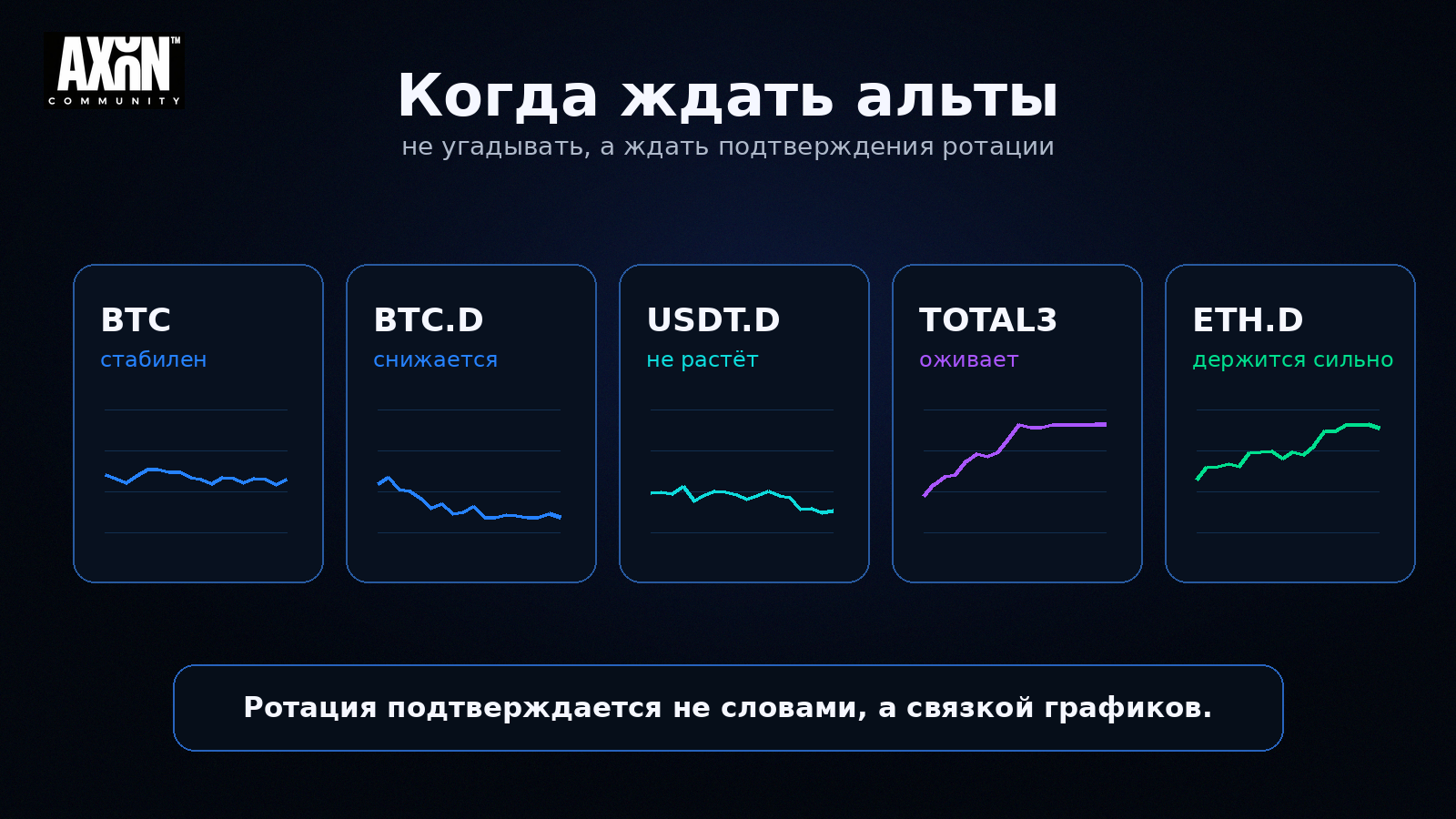
- Fourth - wait for rotation. Alts need a moment when BTC stops stealing all the attention, BTC.D cools down, USDT.D declines, and TOTAL3 starts to come to life.
Signs that rotation is starting
- BTC stops growing vertically and goes into a quiet consolidation.
- BTC.D stops updating growth and begins to decline.
- ETH is starting to look stronger than BTC, or at least holding steady.
- USDT.D is declining, indicating an exit from the stables.
- TOTAL3 penetrates an important zone and holds it.
- Alts begin to grow not one at a time, but more widely: several sectors come to life at the same time.
What is important to remember
The growth of BTC is not equal to the growth of alts. Alts need their own influx of capital.
If BTC rises along with BTC.D, the market may choose Bitcoin over broad risk.
If TOTAL3 is weak, the altcoin sector does not receive normal liquidity.
You don't need to buy violas just because they haven't grown. We need to wait for confirmation of strength.
The professional approach is to see where the capital is going and not just react to the green BTC candle.